
Fiber Optic Distribution Box | LGX Box Splitters
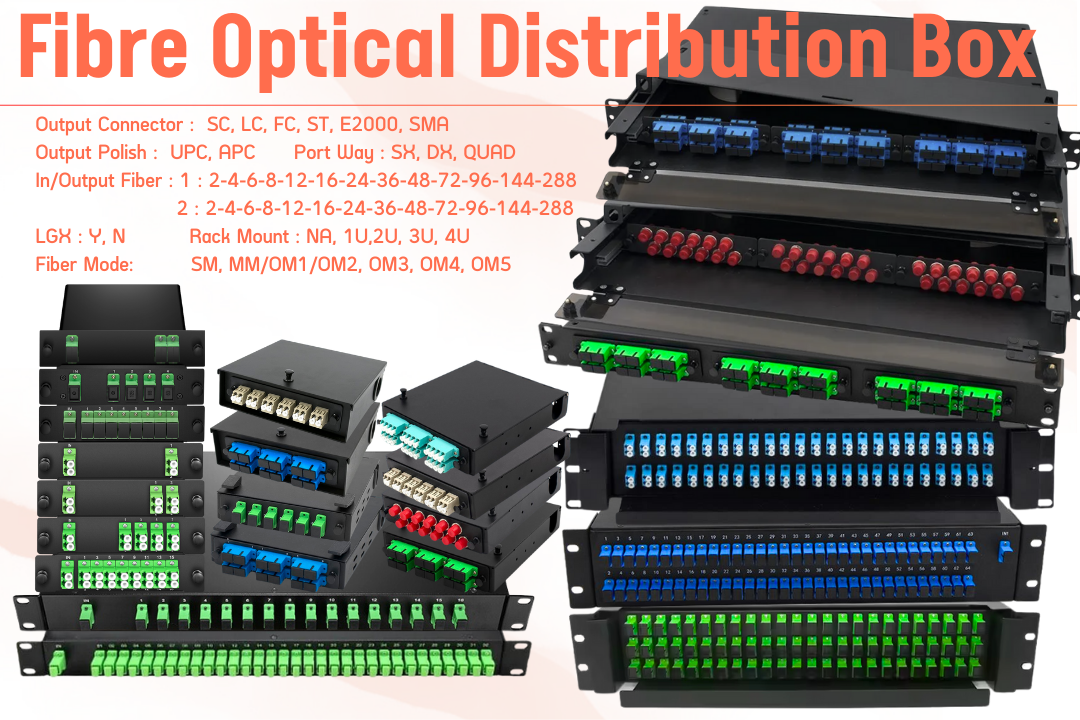
What is a Fiber Distribution Box (FDB)?
A Fiber Distribution Box (FDB) is a critical component in fiber optic networks, designed for signal distribution, splicing, and termination. It acts as a centralized junction point where optical fibers are organized, connected, and protected. FDBs are commonly used in Fiber-to-the-Home (FTTH) and Fiber-to-the-Building (FTTB) deployments, enabling efficient fiber management in both indoor and outdoor environments.
Key Features of FDBs:
-
Fiber splicing & termination – Equipped with splice trays and adapters for secure connections.
-
Flexible installation – Available in wall-mounted, pole-mounted, and rack-mounted configurations.
-
Scalability – Supports various fiber capacities (e.g., 2-core to 48-core).
-
Protection & durability – Designed to withstand environmental factors (dust, moisture, and mechanical stress).
Classification of Fiber Distribution Boxes
FDBs can be categorized based on application, installation method, and fiber capacity:
1. By Application
-
Indoor FDBs – Used in controlled environments (e.g., data centers, telecom rooms).
-
Outdoor FDBs – Built to endure harsh weather conditions (IP55 or higher protection).
2. By Installation Method
-
Wall-mounted – Compact design for space efficiency.
-
Pole-mounted – Ideal for aerial fiber deployments.
-
Rack-mounted (e.g., 19-inch 2U chassis) – Used in data centers for high-density fiber management.
3. By Fiber Capacity
-
Low capacity (2-core to 12-core) – Suitable for small-scale deployments.
-
Medium capacity (16-core to 24-core) – Common in residential and commercial FTTH setups.
-
High capacity (48-core and above) – Used in enterprise and data center networks.
Advantages of Using Fiber Distribution Boxes
-
Enhanced Network Reliability
-
Protects fiber splices from dust, moisture, and physical damage.
-
Reduces signal loss and network downtime.
-
-
Simplified Installation & Cost Efficiency
-
Pre-configured designs speed up deployment.
-
Minimizes labor and maintenance costs.
-
-
Scalability for Future Expansion
-
Modular designs allow easy upgrades without replacing the entire unit.
-
-
Compatibility & Flexibility
-
Supports various fiber connectors (SC, LC, FC, etc.).
-
Adaptable to different network architectures (FTTH, FTTB, FTTC).
-
Quality & Protection Standards
FDBs must meet specific Ingress Protection (IP) ratings based on their environment:
| Type | IP Rating | Protection Level |
|---|---|---|
| Outdoor FDB | IP55 | Dust-resistant, waterproof against water jets |
| Indoor FDB | IP20 | Basic dust protection, not waterproof |
Material Considerations
-
ABS Plastic – Affordable, good impact resistance (standard environments).
-
ABS+PC Blend – Enhanced durability and temperature resistance.
-
SMC (Sheet Molding Compound) – Superior strength for extreme conditions.
FDB vs. FTB: What’s the Difference?
| Feature | Fiber Distribution Box (FDB) | Fiber Terminal Box (FTB) |
|---|---|---|
| Primary Use | Fiber distribution & splicing | Fiber termination & protection |
| Installation | Wall/Pole/Rack-mounted | Typically wall-mounted |
| Function | Manages multiple fiber connections | Protects individual fiber terminations |
| Capacity | Higher (up to 48+ fibers) | Lower (usually 1-12 fibers) |
How to Choose the Right FDB?
-
Assess Fiber Capacity Needs
-
Current requirements + future expansion.
-
Choose between 16-core, 24-core, or 48-core models.
-
-
Determine Installation Environment
-
Outdoor? → IP55+ rated, weatherproof.
-
Indoor? → Standard IP20 is sufficient.
-
-
Select the Right Material
-
ABS/PC for general use.
-
SMC for extreme conditions.
-
-
Consider Installation Method
-
Wall-mounted for homes/small offices.
-
Rack-mounted for data centers.
-
Conclusion
The Fiber Distribution Box (FDB) is a vital element in modern fiber optic networks, ensuring efficient signal distribution, protection, and scalability. Whether for FTTH, FTTB, or enterprise networks, selecting the right FDB—based on capacity, environment, and material—ensures long-term reliability and performance.
By investing in a high-quality FDB, network operators can reduce maintenance costs, improve signal integrity, and future-proof their infrastructure for evolving connectivity demands.
CaiLi Telecom
Jul. 2025
Why OTDR Launch Cable ? OTDR Extension Test Line Fiber Ring Introduction

